CHEN Haoxuan: Don’t Fall Before We Fade: Curated by WANG Yaoli
“I have always been searching for ways to endow life with intensity and fervor—perhaps through the conviction in every choice, or the dauntless resolve when facing the unknown.” — CHEN Haoxuan
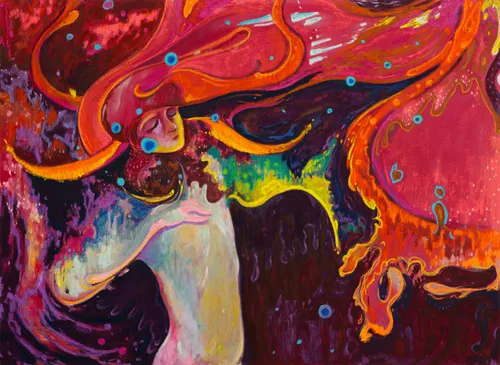
BONIAN SPACE is pleased to announce the opening of Don’t Fall Before We Fade, a solo exhibition by artist CHEN Haoxuan, running from April 11 to May 9, 2026. Curated by WANG Yaoli, the exhibition features over ten important works created by the artist in recent years. Working primarily in painting, CHEN focuses on the instabilities of the individual within emotion and experience, engaging with themes such as intimacy, desire, and self-cognition. His work tends to present fragments of a process, maintaining an open and fluid state within the imagery that generates a sustained internal tension. In terms of methodology, he combines oil paint, oil sticks, and other materials through layered applications, developing the painting process through immediate perception and gesture, gradually constructing compositions with a distinct visual density.
Don’t Fall Before We Fade points toward a state of “not-yet-arrived” rather than a completed teleology of rebirth. CHEN Haoxuan’s imagery, motifs such as wings, falling, burning, and submersion, recur persistently. These elements simultaneously evoke flight and freedom while implying constraint and expenditure. The desire for ascent and the inevitability of descent coexist within the same structure, rendering emergence and dissolution inseparable.
In Ecstasy (2025), interwoven bodies within flames form a structure that is both oppressive and entangled. The central figure is enveloped within this configuration, entering a near self-forgetting state of immersion. Warmth and harm unfold simultaneously within the same field, making perception difficult to clearly distinguish. Obsession (2026) employs flowing lines and uncanny figures to probe the internal dynamics of desire; within cascading, waterfall-like light, a fleeting moment emerges—one in which the subject perceives its own void. In Deep Night Fills the Sky (2026), fractured wings and viscous, heavy chromatic matter articulate the persistence of trauma. The weight of life becomes almost materialized, while a blood-red sky establishes an inescapable condition of suffering.
Concurrently, works such as The Heart Soars (2026) and Aliferous (2026) unfold on another angle: the imagery leans toward luminosity and weightlessness, yet never fully detaches from a certain gravitational pull. The figures exist between zero-gravity and submission, pointing to the possibility of flight while implying an acceptance and surrender to invisible forces. Thus, flight is no longer merely a yearning for freedom, but rather a state of constant recalibration within constraints—a fragile equilibrium maintained between ascent and collapse.
Across different works, CHEN continuously adjusts the positioning and dynamics between his figures, allowing for multi-referential possibilities within the frame. He does not impose definitive narratives upon these figures, whose identities and genders are intentionally attenuated; instead, he places them within open and ambiguous structures. Between gazes and misalignments, the figures maintain a subtle distance between proximity and alienation, keeping their relationships in a state of perpetual tension. In this sense, the paintings function as a manifestation of relational structures, echoing the tenets of “relational ontology”—the notion that individuals are not isolated entities but are continuously shaped and transformed through relationships, interactions, and processes. CHEN’s practice shifts the focus from “being” to “becoming,” transforming the image into a visible form of this ongoing process.
As CHEN Haoxuan said, that state of “not-yet-arrived” is always accompanied by fervor and contradiction: the storm has not receded but continues to resonate internally, causing life to oscillate between embers and light. Within this recursion, flight is no longer a singular motif of rising, but a capacity that requires constant practice—maintaining direction amidst uncertainty and seeking provisional points of anchorage within states of weightlessness. The exhibition Don’t Fall Before We Fade unfolds precisely such an unfinished process; it is not a confirmation of arrival, but a momentary pause within a continuous state of becoming.
